Sam Johnson Memorial Lecture 4 December 2025

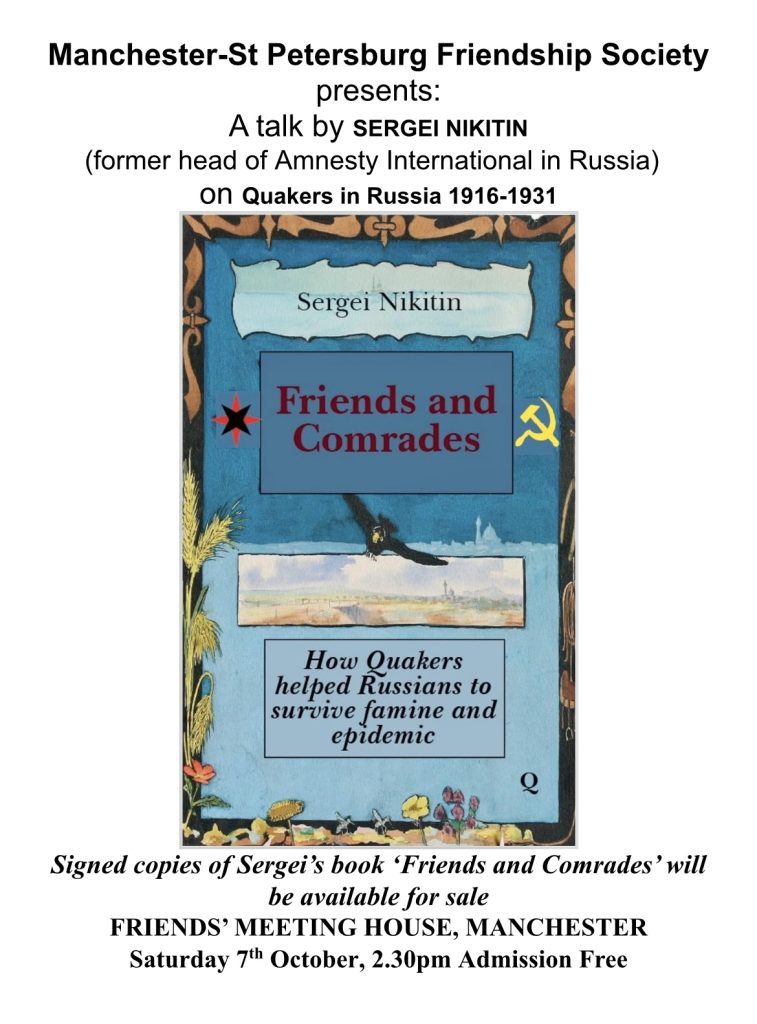
Following the success of Jane Rosen’s Sam Johnson Memorial Lecture in December 2024, the Manchester St. Petersburg Friendship Society was pleased to propose Sergei Nikitin to deliver the 2025 Memorial Lecture.

Lecture title: Friends and Comrades: How Quakers helped Russians to survive famine and epidemic

Date: Thursday 4th December 2025 at 06:00 pm to 08:00 pm

Venue: The Manchester Histories Hub on the Lower Ground Floor of Manchester Central Library.

This is a hybrid event. We warmly encourage you to join us in person at Manchester Histories Hub, where you will have the opportunity to meet the author, purchase a copy of the book, and have it signed. For those unable to attend in person, an online attendance option is available. A link to join will be emailed to registered attendees in the days leading up to the event.

Book free tickets here: Sam Johnson Memorial Lecture 2025 Tickets, Thu, Dec 4, 2025 at 6:00 PM | Eventbrite

More information about Sergei Nikitin and his lecture: In his important book, Friends and Comrades: How Quakers helped Russians to survive famine and epidemic, Sergei Nikitin documents the relief work done by British and American Quakers in Russia during and after the First World War, during the Famine in the Volga basin area. Providing emergency relief, medical aid, and food, Quakers provided essential care to many thousands of the War refugees and ordinary Russians in 1916-1931. Drawing on a wealth of archival sources, diaries, and memoirs, the book explores the fraught relationship between the Friends and the Russian state officials. In this lecture, Sergei presents a story never before told in Russia or in the West: how the Religious Society of Friends worked in Russia under the Tsarist government and the Bolsheviks for 15 years in the 20th century. As the British historian Robert Service said: “Sergei has written an exemplary, vivid, and well-researched account of the Quaker relief mission to Russia.”

Sergei Nikitin was born in Gomel, USSR, in 1957. He studied the physics of semiconductors at the Leningrad Polytechnic Institute and worked at scientific research institutes in Leningrad and Gatchina. Sergei has been involved in historical research work on the Quakers in Russia since 1996. In 1999, he started his job for an international Quaker organisation Friends House Moscow as a director of the office. From 2003 he had worked as the Head of Amnesty International representative office in Russia for 14 years. In June 2017 Sergei retired and moved with his family to High Peak, Derbyshire, UK. His book “When Quakers Were Saving Russia” (in Russian) was published in Moscow in 2020. It was published in the UK – titled “Friends and Comrades. How Quakers helped Russians to survive famine and epidemics” – in 2022.

Statement by the Manchester-St Petersburg Friendship Society

The Manchester St. Petersburg Friendship Society unreservedly condemns the invasion of the sovereign state of Ukraine by Russian forces. We wish to express our solidarity with the Ukrainian people and our support for those in Russia, including in Manchester’s partner city of St. Petersburg, who are advocating and working for peace.
The Manchester St. Petersburg Friendship Society aims to develop friendship and understanding. In the current circumstance we are reviewing our activities and will update our members in due course.


Politics and International Relations Public Lecture Series at MMU

Romanticising the New Silk Road: The Visuals of Chinese-Russian Media

Date: Wednesday 12th February 2020
Time: 1.30pm – 3pm
Location: GM 3.42, Geoffrey Manton Building, Rosamond St West, Manchester M15 6LL
Tickets: Free – Available on Eventbrite

The Belt and Road Initiative (BRI) is arguably the key to China’s contemporary economic strategy. However, there is low understanding and trust towards the project in many of the states in which concrete collaborations are planned or underway. This talk interrogates how the Chinese state has responded to
such skepticism, focusing on media collaboration between China’s and Russia’s state-owned international broadcasters, CGTN, and RT. The particular focus is a 5-part co-produced documentary series aimed at introducing international English-speaking audiences to the metaphorical new ‘Silk Road’.

This series reimagines the economic and infrastructural project in both historically-romantic and futuristic ways, with human stories central to both. But how strategic is this Chinese-Russian media partnership? Situating the series within the broader context of Russian and Chinese political, economic and media strategy reveals certain tensions underlying this collaboration, as well as broader limitations that apply when state actors attempt to reimagine their policy activities via global media.

Precious Chatterje-Doody is a Lecturer in Politics and International Studies at Open University. Her research is focused on communication, perception and foreign policy, with a particular focus on Russia, as well as its international broadcaster, RT.

The Politics and International Relations Public Lecture Series is sponsored by the History, Politics and Philosophy department and organized by Kathryn Starnes, Lecturer in International Relations at Manchester Metropolitan University.


Politics and International Relations Public Lecture Series at MMU

Welfare Reform and the Third Sector in Russia and Belarus

Date: Wednesday 11th March 2020
Time: 1:30pm – 3:00pm
Location: GM 3.42, Geoffrey Manton Building, Rosamond St West, Manchester M15 6LL
Tickets: Free – Available on Eventbrite

Since the collapse of the USSR, post-Soviet countries have been following different paths of development. While some conducted radical political and economic reforms, others made only partial changes to their political and economic structures. However, in both cases there were significant changes in national welfare systems. In Russia since 2000 the welfare system has moved away from the Soviet model of heavy subsidies and broad state social provision to a more mixed model based on means-testing, privatisation and the increasing involvement of non-state actors such as NGOs and commercial enterprises in the provision of social services to different vulnerable groups. In Belarus the state has remained largely responsible for the delivery of social services as it was during the Soviet period, but quality is often poor, eligibility has been tightened since 2007 and there have been nascent attempts recently to involve NGOs in the delivery of social services. At the same time, provision of public welfare continues to be of vital importance in maintaining the legitimacy of the electoral authoritarian regimes in both countries and non-state actors working in this area may have some capacity to have input into the development of welfare policy.

I use data gathered during extensive interviews in both countries in 2015-2018 to answer the following questions: What are the recent developments (and their causes) in welfare policies in Russia and Belarus? How does the political regime in these two post-Soviet states influence opportunities for non-state actors to participate in welfare policy? What role do they play in the national policy process? Are there any windows of opportunities for the non-state actors to increase their influence on welfare policies? And, if so, what are the potential outcomes of such participation?

Biography

Eleanor joined MMU in January 2019. Prior to her current appointment she was Lecturer in Politics at the University of Liverpool and Leverhulme Early Career Fellow at Queen Mary, University of London. She completed her PhD in Russian and EU Politics at the University of Glasgow in 2013 and has held visiting fellowships at the University of Helsinki and New York University. Her research interests include policymaking processes in electoral authoritarian regimes, welfare reform, social policy and social rights in Russia and other post-Soviet states. She is currently working on two research projects: 1) a comparative project on social security and social service delivery in Russia and Belarus and 2) a project in collaboration with Dr Claire Pierson (University of Liverpool) exploring how authoritarian regimes use conservative family policy to achieve political outcomes.

The Politics and International Relations Public Lecture Series is sponsored by the History, Politics and Philosophy department and organized by Kathryn Starnes, Lecturer in International Relations at Manchester Metropolitan University.

Kinemacat (Russian Film Club) at Altrincham Little Theatre

Saturday 15 February 18:30 (Parts 1 & 2) & Sunday 16 February 17:00 (Parts 3 & 4)
War and Peace 
Directed by: Sergei Bondarchuk (1966)

History meets romance in this four-part marathon of the Russian classic blockbuster  (Film & Pizza nights)

A film adaptation of Leo Tolstoy’s epic War & Peace, the four-part cinematic tour de force follows the close-knit Rostov family and their friends through the Napoleonic War.

Lavish in its production, meticulous in historical accuracy and massive in scope, featuring thousands of real-life soldiers in re-enactment battle scenes that called for pioneering camera work, it also sustains an intimate, gripping family drama and haunting romance at its heart. Winner of Golden Globe and Academy Awards for Best Foreign Language Film.  Run time: Part I: 147 minutes Part II: 100 minutes Part III: 84 minutes Part IV: 100 minutes

Tickets £10 – https://www.eventbrite.co.uk/o/kinemacat-18619759289